Querying
Visual query builder
Build DynamoDB Query and Scan operations from pills instead of writing key condition and filter expressions.
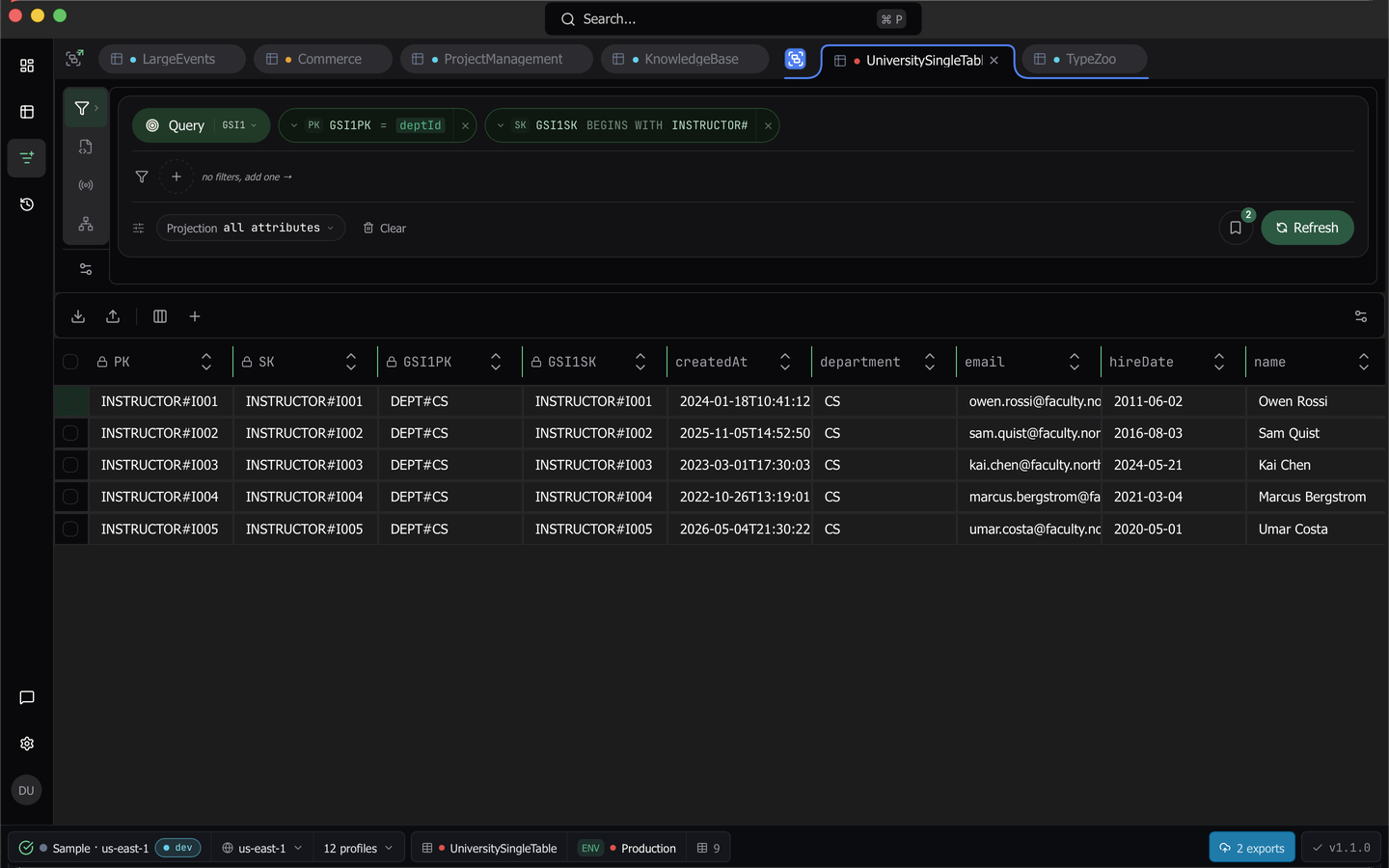
The query builder is the Filters flavor of every query tab. You pick key conditions, filters, an index and a projection from pills, and Dynomatic compiles the expressions and streams the matching items into an editable grid.
Open a table and run it
Open a table from the Tables popover, from the command palette, or from the dashboard’s Recently Opened list. Each table gets its own tab.
A new tab does not read anything until you ask it to. Press Run, or press Cmd+Enter (Ctrl+Enter on Windows and Linux). A readout above the grid reports what came back, for example Fetched 4 items (1KB) in 12ms. After the first fetch the same button is labeled Refresh.
Query by key instead of scanning
A fresh tab starts in Scan mode with the hint no filters, add one →. To switch to a Query, press Add PK / SK condition and choose a partition key from the Partition key group. Choosing one puts the tab into Query mode. Sort key conditions live under the Sort key group, and they stay in Scan until a partition key is added.
Each condition renders as a pill with a field picker, an operator and a type-aware value editor. Booleans, numbers, BETWEEN pairs, IN and NOT IN chip lists and operators that take no value each get the editor they need, and you can override the datatype or type a nested map path. Partition keys lock to =, since that is the only operator DynamoDB accepts there.
Choose an index
The mode pill on the left of the builder names the current operation. Click it to open a menu listing the primary key and every LSI and GSI, each showing its own partition and sort key. Picking one rewrites the key pills for that index and renames the pill to Configure query on index <name>. Three behavior toggles sit below the index list:
- Scan forward returns items in ascending sort key order.
- Consistent read requests a strongly consistent read. It costs twice the read units, so the pill adds a
· consistent 2×tag while it is on, and it is unavailable on GSIs. - Force scan treats the request as a Scan and unlocks every operator on the partition and sort keys.
Vector indexes never appear here. They are queried from the Vector search flavor instead.
Add filters
Press Add filter to open a searchable attribute list. Pick an attribute, or type a name and choose + Custom attribute name for one that has not been seen in a result yet.
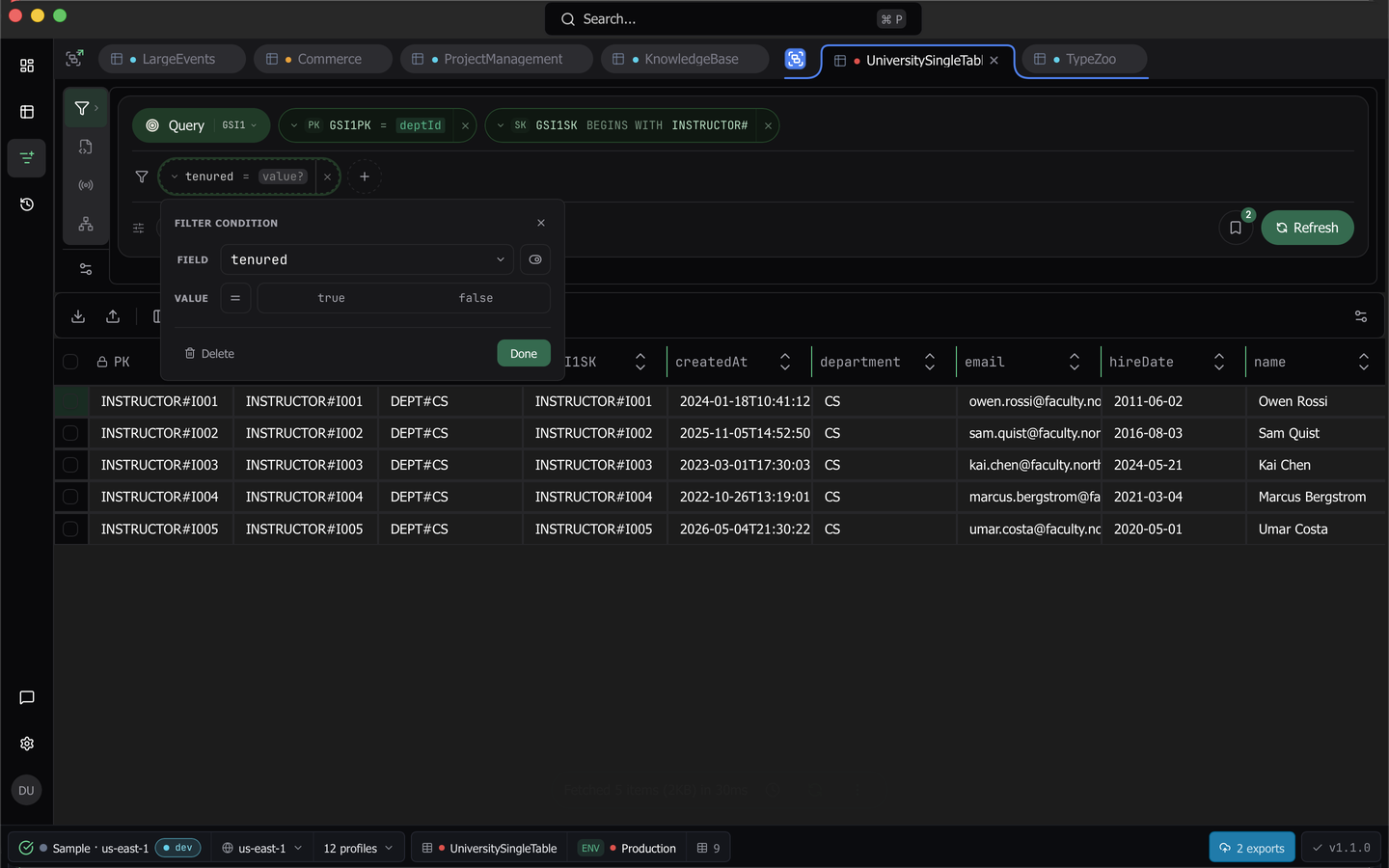
With two or more filter pills present, a connector button sits between them. Click it to flip and to or. Paren glyphs on the pills mirror the precedence of the compiled expression, so (a AND b) OR c reads the way it will run. Clear all conditions empties the builder.
Note: The free plan allows two filter conditions per query. A third requires the Pro plan.
Choose which attributes come back
The Projection pill on the action row states what the next read returns, either Projection all attributes or a list of what is left out. Its popover lists every attribute previous queries and scans have observed as a checkbox, names the key attributes once in an Always projected: line, and offers Reset to default.
Vector attributes are unchecked by default, so a scan of a table carrying embeddings does not drag megabytes of vectors back with it. The choice is saved per table.
Work with the results
Results stream in as they arrive. Below the grid you get Load more results, Cancel loading and Refresh results, plus a live progress label showing items, bytes and elapsed time. The byte figure is the measured size of the payload that came back, not an estimate.
Once results exist, an Auto-refresh control appears. It offers Off, 5s, 10s, 30s, 1m and 5m, plus a Skip command history checkbox so a polling tab does not fill up your history. The setting lives on that tab for the session only.
Editing, bulk actions and committing changes are covered in the data grid.
Save a query for later
Saved queries stores the current pills under a name, per table. Reopening one restores the conditions, the index and the mode. The popover lists each saved query with its age and a delete button, and the trigger shows the count. Saved queries require the Pro plan.
When nothing loads
When a tab opens with an empty grid, Dynomatic deliberately read nothing and the empty state says why. Auto-scan is off for production workspaces, off for tables that carry a vector index (a scan is charged for every item’s full vector even when the vector is left out of the results), and off wherever you turned it off yourself at the table, workspace, environment or global level. Each message carries a link to the setting that governs it. Press Run whenever you are ready to read.
Last updated on